


Embedded Systems Roadmap 2026: Complete Beginner-to-Professional Guide

Updated: Jul 16
Embedded systems power the modern world. From smartphones, smartwatches, automobiles, industrial automation systems, medical devices, drones, IoT products, and consumer electronics, embedded systems are everywhere.
If you're a student, hobbyist, or aspiring engineer wondering how to start learning embedded systems in 2026, this roadmap will guide you step-by-step from the fundamentals to advanced industry-level concepts.
By following this roadmap, you'll develop the skills needed to build real-world products and pursue careers in Embedded Systems, Firmware Development, IoT, Robotics, Automotive Electronics, and Industrial Automation.

What is an Embedded System?
An Embedded System is a specialized computer designed to perform a specific function within a larger device or system.
Unlike a desktop computer, which performs multiple tasks, an embedded system is optimized for a particular application.

Examples include:
Smart Washing Machines
Smart TVs
Air Conditioners
Automotive ECUs
Industrial Controllers
Smart Door Locks
Medical Monitoring Devices
Drones
IoT Devices
Wearable Electronics
An embedded system typically consists of:
Microcontroller or Processor
Sensors
Actuators
Memory
Communication Interfaces
Embedded Software/Firmware
Stage 1: Learn Electronics Fundamentals
Before writing code, you must understand how electronic circuits work. Many beginners jump directly into Arduino programming and struggle later because they lack electronics fundamentals.
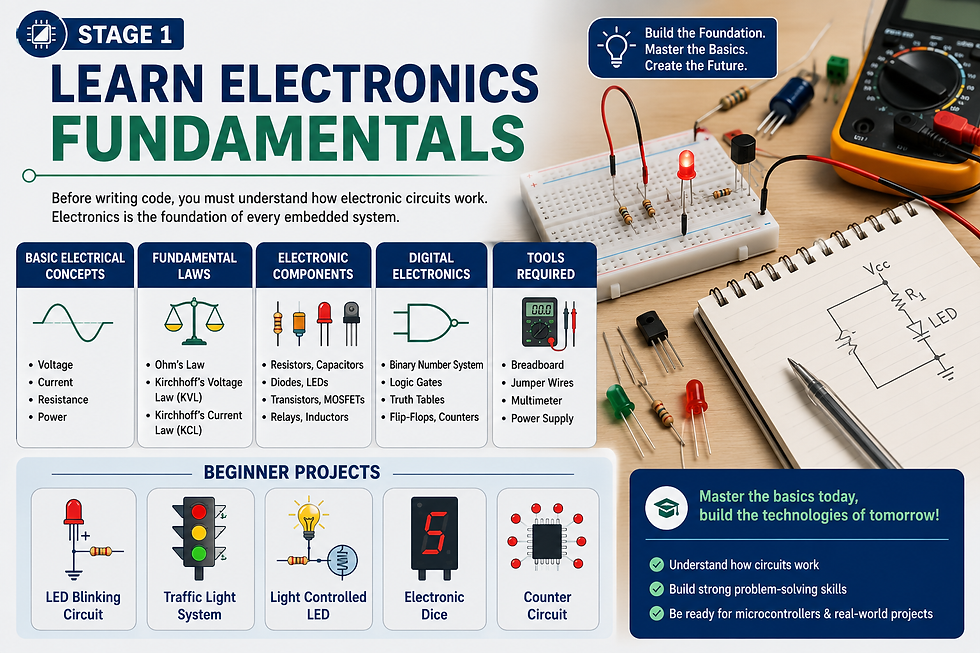
Topics to Learn
Basic Electrical Concepts
Voltage
Current
Resistance
Power
Fundamental Laws
Ohm's Law
Kirchhoff's Voltage Law (KVL)
Kirchhoff's Current Law (KCL)
Electronic Components
Resistors
Capacitors
Inductors
Diodes
LEDs
Transistors
MOSFETs
Relays
Digital Electronics
Binary Number System
Logic Gates
Truth Tables
Flip-Flops
Multiplexers
Counters
Tools Required
Breadboard
Jumper Wires
Multimeter
Power Supply
Beginner Projects
LED Blinking Circuit
Traffic Light System
Light Controlled LED
Electronic Dice
Check out our Course on Introduction to Electronics!!

Stage 2: Learn C Programming
C is the foundation of embedded programming. Almost every microcontroller platform relies heavily on C. A strong understanding of C will make it much easier to learn STM32, ESP32, RTOS, Device Drivers, and Embedded Linux later.

Topics to Learn
Basics
Variables
Data Types
Operators
Conditional Statements
Loops
Intermediate Concepts
Functions
Arrays
Strings
Structures
Enums
Advanced Concepts
Pointers
Function Pointers
Dynamic Memory Allocation
Bit Manipulation
Why Pointers Matter
Pointers are used extensively in:
Device Drivers
Memory-Mapped Registers
RTOS Development
Embedded Linux
Practice Ideas
Calculator Program
Student Management System
Number Guessing Game
Menu Driven Programs
Check our Free Course on C Programming here.

Stage 3: Start with Arduino
Arduino is one of the best platforms for beginners. It helps you learn embedded concepts without worrying about complex hardware configurations.

Topics to Learn
GPIO
Digital Input
Digital Output
PWM
LED Brightness Control
Motor Speed Control
ADC
Reading Analog Sensors
Interrupts
External Interrupts
Timer Interrupts
Sensors to Interface
Ultrasonic Sensor
DHT11/DHT22
Soil Moisture Sensor
LDR Sensor
IR Sensor
Beginner Projects
Smart Plant Monitoring System
Distance Measurement System
Automatic Street Lights
Home Automation System
Weather Monitoring Station
Goal of this Stage
Learn how hardware and software interact.
We have Arduino DIY KITs for you an the best part is, each KIT comes with a Free Course:
Arduino Beginners KIT
Arduino Intermediate KIT
Arduino Advanced KIT
Stage 4: Move to Professional Microcontrollers
Once you're comfortable with Arduino, it's time to move toward industry-grade microcontrollers.

STM32
STM32 is widely used in:
Automotive Electronics
Industrial Automation
Medical Devices
Consumer Electronics
ESP32
ESP32 is excellent for:
IoT Products
Wi-Fi Applications
Bluetooth Devices
RP2040
RP2040 is ideal for:
Learning Embedded Concepts
Custom Hardware Development
Educational Projects
Learn Concepts Like -
Timers
Used for:
PWM
Delays
Frequency Measurement
UART
Used for serial communication.
SPI
Used for high-speed peripheral communication.
I2C
Used for sensors and displays.
DMA
Allows peripherals to transfer data without CPU intervention.
Tools
STM32CubeIDE
Arduino IDE
VS Code
ESP-IDF
Projects
Smart Energy Meter
Data Logger
Wireless Sensor Node
Industrial Monitoring System
and many more...
Stage 5: Master Communication Protocols
Communication protocols are essential because embedded devices rarely work alone.

UART
Applications:
Debugging
GPS Modules
GSM Modules
I2C
Applications:
OLED Displays
RTC Modules
Environmental Sensors
SPI
Applications:
SD Cards
TFT Displays
Flash Memory
CAN Bus
Applications:
Automotive Electronics
Industrial Automation
RS485
Applications:
Long-Distance Industrial Communication
USB Basics
Learn:
USB Architecture
USB HID
USB CDC
Project Idea
Create a multi-node sensor network communicating using UART, I2C, SPI, or RS485.
Stage 6: Learn RTOS
Real-world products often run multiple tasks simultaneously. This is where an RTOS becomes important.

What is RTOS?
RTOS stands for Real-Time Operating System. It manages tasks efficiently and ensures timing requirements are met.
Learn FreeRTOS
Key Concepts
Tasks
Independent pieces of code.
Queues
Used for inter-task communication.
Semaphores
Used for synchronization.
Mutexes
Prevent resource conflicts.
Scheduling
Determines task execution order.
Projects
Smart Home Controller
Industrial Data Logger
Environmental Monitoring System
Stage 7: Learn Hardware and PCB Design
A complete embedded engineer should understand both hardware and software.

Schematic Design
Learn:
Component Selection
Circuit Design
Power Supply Design
PCB Design
Learn:
PCB Layout
Routing
Ground Planes
Design Rules
Recommended Software
KiCad
EasyEDA
Altium Designer
Project
Design your own development board using:
STM32
ESP32
RP2040
Stage 8: Advanced Topics
After mastering the fundamentals, move to advanced embedded technologies.

Embedded Linux
Learn:
Linux Basics
Bash Commands
Buildroot
Yocto
Cross Compilation
Device Drivers
Learn:
Character Drivers
Platform Drivers
Linux Device Tree
IoT
Learn:
MQTT
HTTP
Cloud Integration
Edge AI and TinyML
Learn:
TensorFlow Lite
Edge Impulse
Model Deployment on Microcontrollers
Advanced Projects
AI-Based Plant Disease Detection
Smart Security System
Edge AI Surveillance Device
Predictive Maintenance System
Portfolio Projects to Build
Employers care more about projects than certificates. Build at least 5–10 quality projects.
Recommended projects:
Smart Home Automation System
IoT Weather Station
Smart Door Lock
Industrial Monitoring System
GPS Vehicle Tracking System
Smart Agriculture System
Data Logger
AI-Based Plant Disease Detector
Smart Energy Meter
Autonomous Robot
Common Mistakes Beginners Make
Skipping Electronics Fundamentals - Electronics is the foundation of embedded systems.
Learning Too Many Platforms - Master one platform before moving to another.
Copy-Pasting Code - Understand every line of code you use.
Ignoring Datasheets - Datasheets are essential in professional embedded development.
Avoiding Debugging - Debugging is one of the most important skills for an embedded engineer.
6-Month Embedded Systems Learning Plan
Month 1
Electronics Fundamentals
Basic Circuit Building
Month 2
C Programming
Month 3
Arduino Projects
GPIO, PWM, ADC
Month 4
STM32 or ESP32
UART, SPI, I2C
Month 5
RTOS
Communication Protocols
Month 6
PCB Design
Portfolio Project
Career Opportunities in Embedded Systems
After completing this roadmap, you can pursue roles such as:
Embedded Systems Engineer
Firmware Engineer
IoT Developer
Robotics Engineer
Automotive Embedded Engineer
PCB Design Engineer
Hardware Design Engineer
Device Driver Developer
Embedded Linux Engineer
Final Thoughts
Embedded Systems is one of the most rewarding engineering domains because it combines hardware, software, communication, and problem-solving into a single field.
The best way to learn embedded systems is not by watching endless tutorials but by building projects, making mistakes, debugging hardware, and continuously improving your skills.
Start with the fundamentals, follow the roadmap step-by-step, and focus on creating real-world projects.
Consistency beats speed. One project completed is worth more than ten tutorials watched.
If you're ready to start your embedded systems journey, explore our courses, development kits, tutorials, and project resources at LearnElectronics India and begin building the skills that industry demands.
Check Out our Training & Internship Programs
Upcoming - 6 Months Training & Internship Program
The IO games are seriously addictive. Starting small and gradually becoming the Web Games player everyone else needs to watch out for gives every match that competitive edge. The real-time leaderboard makes even a quick session feel like you have something to prove.